
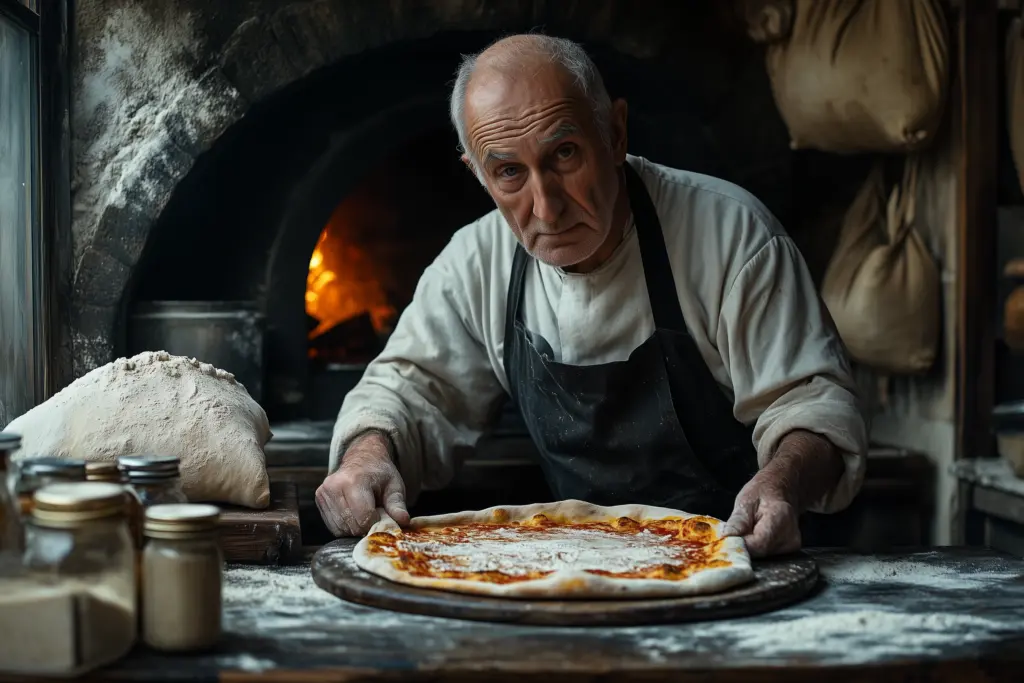
The Origins of the Sacred Dough
Long before modern pizzaiolos perfected the art of the Neapolitan pie, before delivery apps turned pizza into a commodity, before deep dish and thin crust divided the faithful, there was only the dough, the fire, and the hands of the devoted. The earliest civilizations knew that bread was sacred, but it wasn’t until the first baker stretched the dough thinner, spread sauce upon it, and let it cook in the divine flames that the world took its first bite of pizza.
This was the birth of the Holy Crust.
Though modern ovens have streamlined the process, the true believers know that to understand pizza is to understand its roots. The wisdom of the ancients still holds today, for even with all our advancements, there is no substitute for the time-honored techniques that gave us the first perfect pies.
To honor the slice, we must go back-to the fires of Rome, to the ashes of Pompeii, to the bread ovens of Naples. We must discover the Holy Crust.
The First Fire-Baked Breads: The Birth of a Sacred Tradition
Thousands of years before the first pizza, humans understood that fire was the key to transforming dough into something greater. In ancient Mesopotamia, Egypt, and Greece, bakers experimented with flattened bread cooked over open flames, sometimes adding herbs, oils, and even cheeses. These early variations may not have been pizzas as we know them today, but they laid the foundation for what was to come.
The Romans took this a step further. Panis focacius, an early ancestor of both focaccia and pizza, was baked in wood-fired ovens, brushed with olive oil, and sometimes adorned with garlic, onions, and cheese. Roman soldiers, marching across their empire, carried simple flatbreads as rations, unknowingly spreading the gospel of the future crust.
Yet it was in Naples that the Holy Crust reached its full form. The convergence of fire, fermentation, and fresh ingredients birthed the perfect marriage of dough, sauce, and cheese. This was no longer just bread. This was something divine.
The Power of Fermentation: The Secret Ingredient of the Holy Crust
The difference between a mediocre crust and a truly transcendent one is found in time. The ancient pizzaiolos understood that dough must not be rushed.
True pizza dough is not made in haste. It is not thrown together with instant yeast and hurried into an oven. It rises, it rests, it develops character.
Fermentation is the process through which humble flour and water become something greater than the sum of their parts. The Romans allowed their dough to ferment for days, creating a crust with a complex flavor, a light and airy structure, and a crisp-yet-chewy bite. Today, many Neapolitan pizzaiolos still follow these ancient techniques, allowing their dough to ferment naturally, just as the first bakers did.
The lesson is clear: to rush the dough is to forsake the crust.
The Sacred Heat: The Importance of the Wood-Fired Oven
Of all the gifts the ancients gave to the world of pizza, none is as essential as the wood-fired oven.
Modern convenience has given us electric ovens, gas-powered pizza stones, and even conveyor belts that churn out lifeless imitations of the real thing. But the true believers know that pizza must be forged in fire.
The ancient Neapolitans perfected the art of baking in ovens made of stone and brick, heated to blistering temperatures by burning wood. These ovens, capable of reaching 900°F (480°C), created the signature leopard-spot char, the delicate balance of crunch and chew, and the quick, even bake that defined the perfect crust.
Wood-fired ovens provide something no industrial oven can replicate: the spirit of the flame.
A pizza cooked in such an oven is alive, its crust blistering in seconds, its flavors enhanced by the whispers of the smoke, its cheese bubbling under the intense but fleeting kiss of fire.
The Lost Techniques: What Modern Pizza Has Forgotten
While pizza has spread across the world, many of the sacred baking techniques have been abandoned in the name of efficiency. Fast food chains, frozen pizzas, and delivery services have led to the loss of the very methods that once defined the Holy Crust.
Some of these forgotten techniques include:
-
Stone-ground flour, which retains more natural flavor and texture than heavily processed commercial flours.
-
Slow fermentation, allowing wild yeasts to develop natural complexity in the dough.
-
Hand-stretching, ensuring a perfectly airy and tender base rather than the uniform, machine-pressed discs of the modern era.
-
Minimal toppings, honoring the philosophy that a perfect pizza does not need to be overloaded.
-
High-temperature baking, which prevents a crust from becoming dense and dry.
Many modern pizzerias have returned to these principles, recognizing that the old ways were the best ways.
The Crust as a Symbol of Devotion
In Crustianity, the crust is not just an edible component of pizza-it is a metaphor for patience, tradition, and respect. The ancients knew this. They did not waste their crusts, nor did they cut corners in the baking process. Every pizza, every loaf of bread, every carefully kneaded piece of dough was an offering of time and skill.
A true Crustian understands that the best things in life-like the best pizzas-take time.
Just as the faithful must let the dough rise, so too must they allow their lives to develop naturally. Just as the crust must be exposed to fire to reach perfection, so too must the spirit endure trials to achieve greatness.
To bite into a perfectly baked pizza, one that has been made with care and patience, is to taste history, to experience a tradition passed down through the ages.
The Final Slice
The Holy Crust is not just about taste. It is about history, about honor, about the connection between the first pizzaiolos and those who still practice the craft today. The ancient baking techniques that gave us the first pizzas remain the gold standard, proving that the pursuit of perfection is not found in shortcuts, but in dedication to the craft.
If one seeks to make a truly divine pizza, they must return to the roots of the Holy Crust. They must embrace the slow rise, the wood-fired heat, the balance of tradition and artistry.
For as Cheesus Crust once said, “A rushed dough is a regretful bite, but the patient hand shall taste perfection.”
May your crust be blistered but never burnt. May your dough be risen but never rushed. And may you always remember that to honor the crust is to honor the past.