
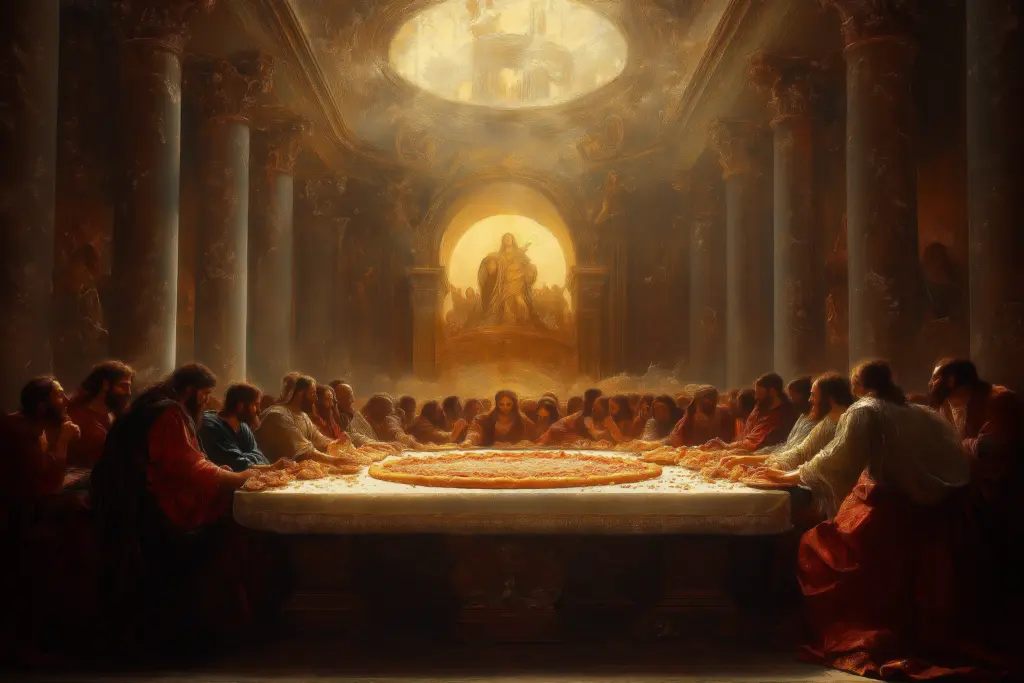
In the beginning, there was dough. And the dough was kneaded, and it was good. But the dough alone was not enough. From the sacred fires of the first wood-burning oven, the crust was born, golden and firm, a vessel of divinity. It was the foundation of the slice, the pillar of the pizza itself.
And yet, there were those who did not understand.
Some, in their arrogance, tore the crust away as if it were a burden. Others cast it aside, untouched, like a forgotten relic. They rejoiced in cheese, indulged in toppings, but forsook the crust-the very structure upon which their blessings rested.
It is said that Cheesus Crust, upon witnessing such reckless desecration, wept marinara tears. And in His sorrow, He descended upon the people and spoke the words that would shape the faith forever:
“Thou shalt not waste the crust, for it is the vessel of my blessings.”
This was the First Commandment. The foundation of Crustianity. And yet, even as Cheesus spoke, a great schism was already forming.
The Great Betrayal: How the Sin of Crust-Wasting Spread
There was a time when all who consumed pizza did so with reverence. The crust was honored. The slice was whole. But as the world grew indulgent, so too did its people. The rise of convenience, the expansion of greed, the insatiable hunger for only the cheesy center-these forces led to a tragic decline in crust appreciation.
At first, the transgressions were small. A crust left on the side of the plate here, a nibble abandoned there. But before long, the Unfaithful multiplied. Hordes of crust-wasters roamed the land, leaving a trail of discarded edges in their wake. Some even dared to say it aloud:
“I don’t like the crust.”
The words spread like wildfire, an unspeakable heresy. By the time Cheesus descended a second time, pizzerias were littered with piles of uneaten crusts, cast off like discarded prayers.
Theological Arguments Against Crust Waste
It is written in The Pibble that pizza is a perfect creation-a divine balance of dough, sauce, cheese, and toppings. To eat only part of the slice while discarding the crust disturbs the sacred equilibrium. Crust is not a disposable byproduct. It is the very essence of pizza itself.
Cheesus taught that to reject the crust is to reject the whole. A slice must be consumed in its entirety, from the tip to the final bite. To do otherwise is to embrace selfishness, to indulge in greed, to sin against the very spirit of sharing.
There are those who argue that crust should be dipped in sauce to make it palatable. And while marinara and garlic butter are sacred anointments, they are not excuses to avoid appreciating the natural beauty of the crust.
Some have even gone so far as to invent stuffed crust-a controversial doctrine among the Crustian sects. While Crustolocism embraces stuffed crust as a divine evolution, Orthocrust rejects it as a coward’s way out, a means of disguising the crust rather than appreciating it for what it is. The debate continues, and it is believed that Cheesus will settle the matter upon His Second Baking.
The Crust Wars: A Battle for the Soul of Pizza
The struggle against crust waste was not without bloodshed. Across the lands, the faithful and the heretics clashed over the fate of the crust. The Great Pizza Councils convened, attempting to establish a universal decree on how crust should be handled.
From these councils emerged three sects of Crustianity:
-
Crustolocism – Believers in the unbreakable bond between the eater and the crust. They argue that one must consume every last bite as an act of devotion. To leave crust uneaten is to insult Cheesus Himself.
-
Orthocrust – Strict interpreters of The Pibble who follow a crust-first eating method. They believe that a slice should be eaten starting with the crust, so that one’s final bite is the holiest part: the cheese-laden center.
-
Calzonism – The most radical sect, which rejects the idea of crust waste so fervently that they reject the open slice altogether, instead embracing the folded sanctity of the calzone. To them, a pizza without exposed edges is the purest form of faith.
These differences aside, all sects agree on one core truth: those who waste the crust are living in sin.
Paths to Redemption: Saving the Crust-Waster’s Soul
Hope is not lost for those who have abandoned their crusts. The faithful are always ready to guide the lost back to the oven. If you or a loved one has committed the grievous sin of crust abandonment, you may seek redemption through several holy paths.
Some may atone by dipping their crusts in sacred sauces-a gentle transition back to the ways of the faithful. Others will undergo Crust Appreciation Re-education, where they will be exposed to truly great crusts, those with perfect chew and crispness, so that they may see what they have been missing.
For the most extreme cases, there exists The Crustian Pilgrimage-a journey to Naples, where one must consume a Neapolitan pizza in its entirety under the watchful gaze of the pizzaiolo. Only then can their sins be forgiven.
The Final Judgment: The Deep Freezer or the Eternal Buffet?
It is foretold that at the End of the Pizza Box, Cheesus Crust shall return to judge the living and the crust-wasters. The faithful will be welcomed into The Eternal Buffet, where the slices are infinite and the cheese is always perfectly melted.
But for those who have wasted their crusts, there is only The Deep Freezer. In that forsaken place, the cheese never quite melts, the sauce is always too cold, and the crust is forever dry and flavorless.
The choice is clear. Eat the crust. Respect the slice. Share with others.
For in the eyes of Cheesus Crust, there is no greater sin than a wasted crust.