The Schism That Shook the Faith
For generations, Crustians stood united under a single, sacred truth: Pizza is divine. The faithful gathered in harmony, breaking crust together, celebrating the gift of Cheesus Crust without division.
But then came the topping that shattered the peace.
No one saw it coming. No one could have predicted that a single fruit-sweet, innocent, and sun-kissed-would be the catalyst for the greatest schism in Crustian history.
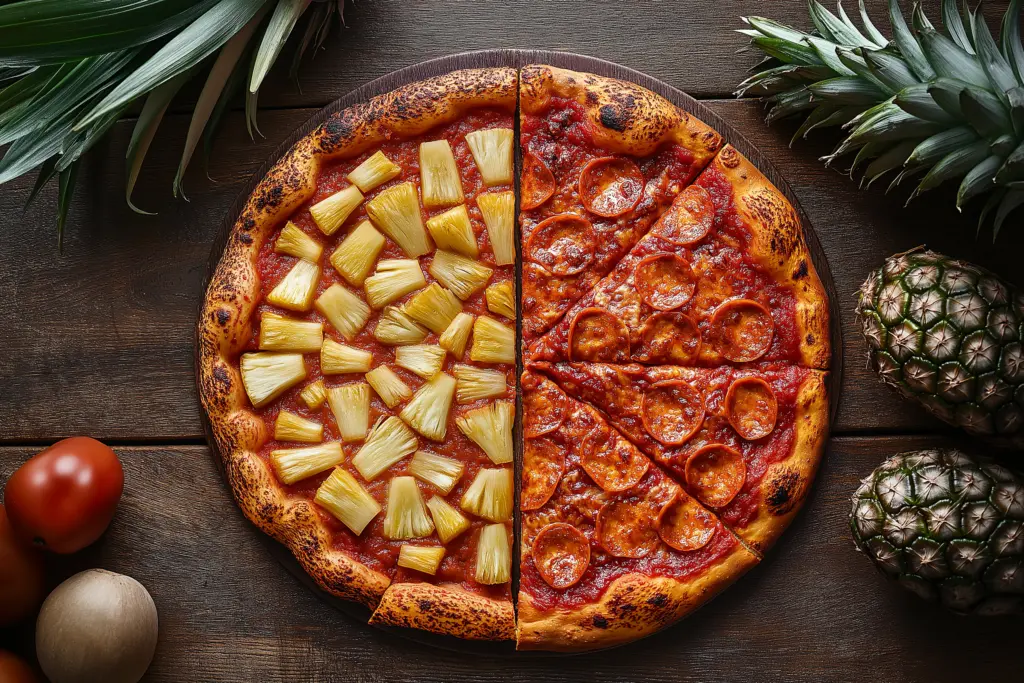
The arrival of pineapple pizza sent shockwaves through the faith. Some called it a revelation, a perfect balance of sweet and savory, a new horizon for pizza itself. Others saw it as heresy, an abomination upon the holy slice, a violation of everything sacred.
And thus, the faith split in two.
Crustolocism vs. Orthocrust: The Two Paths of Faith
In the aftermath of The Pineapple Schism, two factions emerged, each claiming to be the true heirs to the teachings of Cheesus Crust.
The Crustolics embraced all topping combinations, believing that pizza, like faith, should be boundless. “A well-matched pizza is never an abomination,” they declared. “A slice is to be shared, not judged.”
The Orthocrustians, however, held firm to tradition. To them, true pizza was Italian pizza, and pineapple had no place upon its sacred surface. They viewed the spread of pineapple pizza as an insult to the very essence of the slice. “Pizza must remain pure,” they preached. “Let not the sweetness of temptation corrupt the dough.”
At first, the divide was civil. Disagreements were had, words exchanged. But soon, the arguments grew heated. Pineapple eaters were shunned. Anti-pineapple purists were mocked. The tension escalated, and soon, Crustianity found itself on the brink of an all-out pizza war.
The Council of Naples and the Final Decree
In an effort to restore peace to the faith, the most esteemed pizzaiolos of the time gathered in Naples for what would become the most important theological council in Crustian history.
For weeks, the debate raged. Crustolics argued that to reject pineapple was to reject creativity itself, that pizza was meant to evolve. Orthocrustians countered, saying that not all changes are holy, and that if pizza was to remain sacred, it must stay true to its origins.
The air was thick with tension. Dough was thrown. A rogue anchovy struck a scholar in the face. And then, at the height of the chaos, an elder pizzaiolo stood upon the table and delivered the final decree.
The Verdict: A Test, Not a Curse
“Pineapple,” he proclaimed, “is neither heresy nor divine truth. It is a test of faith.”
The council declared that the presence of pineapple on pizza was not a violation of the holy slice, but a trial set forth by Cheesus Crust Himself. A true believer, they said, is not measured by their personal preference, but by their ability to accept that others may enjoy toppings they do not.
And so it was written:
“Judge not thy neighbor’s toppings, lest thy own slice be judged.”
With this decree, the war ended-though the division remained.
What This Means for the Faithful Today
Even now, the scars of The Pineapple Schism linger. The Crustolics continue to champion all toppings, seeing no combination as unholy, while the Orthocrustians hold firm to their traditions, refusing to acknowledge fruit as a valid addition to the sacred pie.
But for the true believer, the lesson remains clear:
Pizza is meant to be shared, not used as a weapon of division.
A Crustian does not have to love pineapple. A Crustian does not have to eat pineapple. But a true Crustian must never let a mere topping become a wedge between them and their fellow believers.
For in the eyes of Cheesus Crust, it is not the toppings that matter most.
It is that we break crust together.